🚀 The Founding 500: Secure Lifetime AI Pro Access for $45 before we switch to monthly subscriptions. [142/500 Slots Claimed]. Claim Yours →
DigitalQRCard Logo DigitalQRCard

Your Business Card Is A Tracking Device

This episode dives into how modern business cards double as tracking devices and what that means for professionals.

In this episode you'll learn about:

  • Why your business card should act as a centralized data hub.
  • Strategies for integrating contact info, analytics and links.
  • Tools and platforms that make this vision practical.

Transcript

Welcome back to the Deep Dive. It is Saturday, February 28th, 2026. And I actually want to start today with a bit of a memorial service. Oh. Who are we mourning today? We are mourning the Reptangle. Specifically that little 3.5 by 2 inch piece of cardstock that really used to define our entire professional existence. Right, the classic paper business card. Exactly. I was cleaning out a desk drawer yesterday, just getting ready for this deep dive, and I found a stack of old business cards from a conference back in, I want to say, 2022. Wow. yeah and holding them i just realized i haven't physically handed one of these to a human being in at least two years maybe longer it really has become an artifact hasn't it it feels almost retro now totally like handing someone a mixed cd or asking them to fax you something it's quaint quaint is a very nice way to put it i was going to say obsolete but that is the thread we're pulling on today we're looking at a stack of sources that paint a very specific picture of what replaced that paper rectangle for you and me And we aren't just talking about, you know, digital contact lists here.

No, not at all. Today we are doing a deep dive into the ecosystem of a platform called Digital QR Code. Ecosystem really is the right word, too, because looking at the source material we have today, we aren't just looking at a simple mobile website. Right. We have user interface screenshots from mid 2025. We have these analytics dashboards that look more like a mission control center than a Rolodex. Yeah, the dashboards are intense. And we have some very interesting marketing materials about custom URL slugs and founding member status. Plus, we have the users themselves. Our sources include actual profiles. We've got a product manager, a data scientist, and arguably the most important profile in the entire stack, a dog named Ellie. I'm so excited to discuss Ellie. I actually think she might be the key to understanding this whole thing. We will definitely get there. But looming over all of this is a headline article from our source stack. It's titled The Rise of AI-Powered Digital Business Guards.

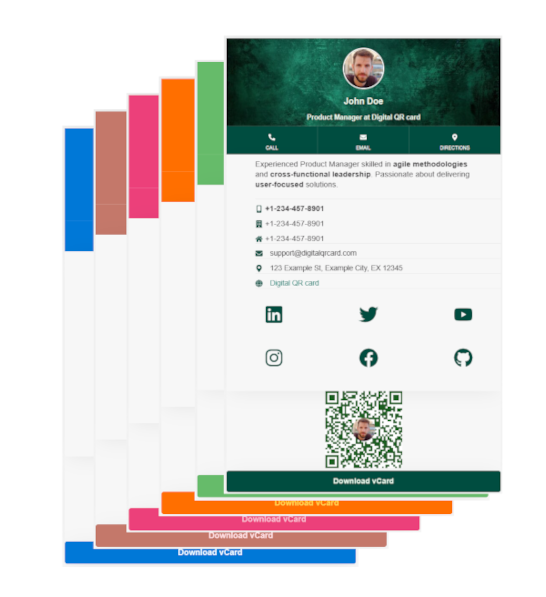
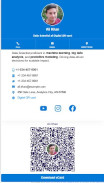
How agentic tools are transforming networking in 2026. Now, agentic is one of those buzzwords I keep hearing everywhere, but I'm not sure I fully grasp how it applies to a well, to a business card. That is the million dollar question for anyone listening today. And that's our mission. We need to figure out how we went from swapping paper, which is a passive sort of hope you call me act to this new world of active data driven AI mediated networking. Okay, so let's start with the visual evidence. We have a source image for the digitalqrcard.com interface. If you're listening right now and you scan a QR code in 2026, what are you actually looking at? Because my initial thought is, isn't this just a web page? On the surface, sure, it's a web page. But look closer at the design hierarchy in that screenshot. What's the very first thing your eye is drawn to? Well, it's not the person's name. It's the buttons. There's this row of massive buttons right at the top. Call, email, and directions. Right.

And that is a very specific design choice called action priority. Action priority. Exactly. Think about the old way. You get a paper card. The friction is incredibly high. You have to read the tiny number, open your phone app, manually type it in, double check that you didn't mess up a digit, and then hit call. I usually messed up the digit, honestly. We all did. But here, the interface reduces that friction to absolute zero. You see call, you tap it, you're speaking. It completely changes the psychology of the interaction from saving info to taking immediate action. It demands a response from you. I also noticed the location is prominent. It says Carlsbad, C-A in this example. But slightly further down the page, there is a big blue button that says Download vCard. Yes. Now, to me, that feels a bit redundant if the call and email buttons are already right there at the top. Why is that specific vCard button so huge? Because that button is the Holy Grail. In marketing terms, that is the conversion event.

How so? I mean, isn't calling a conversion? Calling is great, but if you just visit the page, you're a visitor. You might leave, close the tab, and forget the URL forever. But if you click Download vCard, you are hardcoding that person's data directly into your device's native contact book. You are bypassing the browser and entering the phone's long-term memory. That button prevents you from being forgotten. It's the difference between bribing a store and actually taking the product home with you. That's a perfect analogy. And look at the social integration just above it. Facebook, YouTube, LinkedIn. A paper card is a dead end. This digital card is a hub. It aggregates your entire digital self, your videos, your resume, your social proof into one fully editable portal. Fully editable is a key phrase from the marketing text. And I want to pivot to the humans and non-humans who are actually inhabiting this ecosystem. Let's do it. We have three distinct profiles in our source stack. Let's start with the serious one, the data scientist.

That would be Ali Khan. Right. We're looking at his profile image. It's a sleek, dark blue theme. Very cyber feeling. The biolists, machine learning, big data analysis, and predictive modeling. Ali is the exact archetype driving this shift. He works in predictive modeling. He understands the raw value of data. He isn't going to use a networking tool that doesn't generate analytics for him. Right. He needs the numbers. For him, a paper card is a black hole. Information goes out, nothing comes back. This platform closes the loop. Contrast that with our next profile, John Doe. He's a product manager. His cart is bright green. The color psychology there is interesting, but look at his keywords. Agile methodologies, cross-functional leadership, delivering user-focused solutions. It feels a little buzzword heavy, doesn't it? It is, but that's the currency of his specific field. But did you notice the icons? John has a GitHub icon, the little cat silhouette. Ellie didn't have that. Oh, good catch.

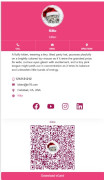
I actually missed that. So the platform allows you to signal different competencies based on your specific industry. Precisely. For a product manager, linking to a code repository like GitHub is a flex. It signals to you, hey, I'm not just a manager. I actually understand the code. Yeah, it proves technical literacy. Exactly. These digital cards allow for nuanced signaling that you just cannot fit on a three by two piece of card stock. You are customizing your interface for your specific audience. Okay. So we have the tech professional signaling competence and the corporate leader signaling leadership, but then we have the profile that completely breaks the mold. We have to talk about Ellie. The absolute star of the show. I am looking at a bright pink digital card. The photo is a closeup of a dog. And she is wearing a tiny tilted party hat. It is objectively adorable. It really is. But read the biotext from the source. It is surprisingly detailed. It says, fully vaxxed, wearing a tiny tilted party hat, possesses playfulness on a brightly colored toy mouse as if it were the greatest prize.

The fully vaxxed detail is what gets me. But why is this here? Why does a dog have a professional networking profile? Is this just a joke by the developers to show off the UI? I don't think it's a joke at all. I think this is evidence of something much bigger. It's the democratization of the technology. Democratization? How do you mean? Think about it. Ten years ago, having a tracked, custom-routed personal website was something you hired a developer for. It was expensive. It was strictly for businesses. Ellie's profile proves that the barrier to entry has dropped to absolute zero. You can create a tracked, location-aware digital identity for a pet in about five minutes. So it's not just for corporate boardrooms in Carlsbad. It's for tracking your dog if she gets lost down the street. Exactly. If someone scans Ellie's physical tag, they get her vaccination status, her owner's contact info, and her location. It proves the utility of the tool extends far beyond just networking. It is identity management.

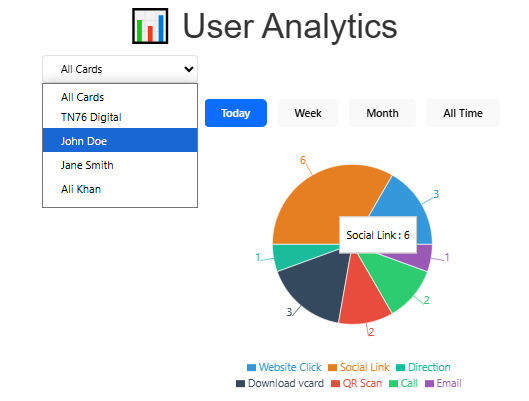
And the pink theme versus Ali's blue theme, it allows for real expression. It's not a standardized white rectangle anymore. It's media. You're curating a piece of media about yourself or your dog. Okay. So the cards are fun. They're colorful. They have big buttons. But I want to get to the part of this deep dive that actually made me a little uncomfortable. We need to look at the user analytics source image. Ah, yes, the dashboard. This is where we leave the fun behind and get into the active part of the equation. This is the engine room. Yeah, I'm looking at a screen titled User Analytics. There is a drop-down menu where you can select profiles, John Doe, Jane Smith, Ali Khan, but the main visual is a pie chart. And what does that chart tell you? It's visualizing engagement. One slice says social link, six. Another is website click. We see direction, call, email, download vCard, and QR Stan. Now stop and think about the difference between this and the paper card. With paper, you hand it over to someone and you walk away.

You have zero data. You don't know if they looked at it, threw it away, or used it to light a fire. Here, every single action is quantified. It is radical transparency. You can see exactly which behavior your card is driving. Are people clicking call or are they just stalking your LinkedIn? If everyone clicks social link but nobody clicks email, maybe your in-person pitch is wrong. You can literally A-B test your own personality. That is incredibly useful. But then I looked at the next source image, which is labeled raw logs. And this is where it felt less like clever marketing and a lot more like surveillance. Raw logs are where the real power lies. It looks like a server readout. We have columns. Type, link, timestamp, IP, and user agent. Let's break those down because they matter to anyone navigating this space. Timestamp. You know down to the exact second, 20, 56, and 37 seconds in the source when someone thought about you. That's intense, just knowing exactly when someone pulled your card up.

Then type in link. You see that they clicked, what up me? That's WhatsApp. So you know they tried to message you. But look at the last two columns, IP and user agent. User agent, that sounds like spycraft to me. The log says Mozilla slash 5.0 open parenthesis Windows NT. What does that actually mean in plain English? A user agent is just a string of text that your browser sends to every single website you visit. It tells the server what kind of device you're using. So here, where we see Windows NT, that tells the analytics engine, hey, this person is on a desktop PC running Windows. If it said iPhone OS 19, you'd know they were looking at your card on their phone. And the IP address. That gives a rough location. Usually much deeper than rough. It can often pinpoint the city or even the specific corporate network they are logging in from. Okay, so let's tie this back to that headline we mentioned earlier, how agentic tools are transforming networking. Because when I hear agentic, I think of an AI acting autonomously on my behalf.

How does a list of IP addresses and Windows NT strings help me do that? This is the crucial lead for where we are in 2026. Right now in the source, we are looking at a dashboard designed for a human to read. But humans are busy. We don't have time to stare at logs all day to see if Steve from the conference clicked our LinkedIn link. So the AI reads the logs. The AI reads the logs. Imagine an agent that monitors this stream 24-7. It sees an IP address associated with, say, Microsoft headquarters, scan your code at 2 p.m. It sees that the user agent is an iPhone. It sees they clicked LinkedIn but didn't actually send the connection request. And the agent does what with that? The agent could ping you and say, hot lead from Microsoft, just view your profile. Or if you give it the right permissions, the agent could automatically find that person on LinkedIn and send a customized connection request saying, hey, great meeting you today. Let's connect. So the business card acts as a sensor. Exactly.

The QR code is the physical sensor out in the real world. The logs are the data stream. And the agendic tool is the hand that reaches out to close the deal. It turns networking from a passive hope into a fully managed sales funnel. That is incredibly efficient. Well, it strips a bit of the romance out of meeting people, doesn't it? It feels very transactional. It is transactional. But Ali Khan, our data scientist, would argue that professional networking is inherently transactional. He knows that data is leverage. Ellie the dog, well, she just wants someone to click the button so she gets a treat. She does not care about the IP address. She definitely does not. But the underlying technology works exactly the same way for both of them. Speaking of leverage and status, we need to talk about the founding member badge in the source material. Because even in a world of cold, hard data, people still really want to show off. Oh, absolutely. The human ego hasn't changed just because the paper card died.

I'm looking at an image of a badge. It's a gold circle, very shiny, with a crown icon sitting right on top of the QR code. It says founding in big letters. This is pure gamification. But why? If the value is the data and the analytics, why do I need a gold crown on my profile? Because digital goods suffer from being infinite. Anyone can have a PDF or a standard profile. How do you signal to someone that you are a VIP? How do you signal that you are here first? Artificial scarcity. Exactly. The founding member status signals early adoption. It tells people you aren't just a casual user, you are an insider. It adds a layer of exclusivity to what is otherwise just a database entry. It's the modern digital equivalent of having your paper card printed on thick, heavy textured stock with gold foil lettering. It's a flex. It is a massive flex. And sticking with that theme of Digital real estate, we have the custom URL slugs update from the marketing materials. The source shows a before and after.

Right. The before is digitalcorecard.com slash question mark card equals 4XYZ. Which looks like a scam link or a virus. It looks messy. It looks temporary. And the after is digitalcorecard.com slash your name. This is pure branding, just like buying a dot-com domain back in the 90s. Securing slash John Doe or slash Alicon is a digital land grab. It makes the link shareable and memorable. If you are telling someone your info verbally, you cannot say slash question mark card equals 4X. You just say slash John. It seems trivial, but in a digital-first world, that URL is your literal nameplate. It is your identity. And notice the business model underlying all of this. The source lists a three-day premium-free offer. Right. It lists three digital cards, unlimited sharing, real-time analytics, and no ads. And what is the most important badge on that promotional flyer? Powered by Stripe. Which means this is a subscription economy. You are renting your professional identity. You pay a monthly fee to keep that founding crown, to keep that custom slug, and crucially to keep your access to those deep analytics logs we talked about.

If you stop paying, the lights go out. Or worse, maybe the ads turn on. Imagine handing a potential employer your digital card. They scan it. And before they can even see your resume, they have to watch a 15-second ad for car insurance. That is a very dystopian thought. Nice to meet you. Please watch this message from our sponsors. That is exactly why you pay the subscription. That is the leverage the platform has over you. So let's zoom out here. We have looked at the action buttons, the dogs and party hats, the raw data logs and the gold crowns. We are sitting here in 2026. What is the actual takeaway for the person listening to this right now? Is this just for tech people like Ali Khan? I don't think so.


Networking Powered by Intelligence

DigitalQRCard isn't just a digital link—it’s a networking co-pilot. While others faff with paper, our Founding Members use AI to capture, score, and sync leads instantly.

The Vision

A world where every connection is actionable. Our AI doesn't just store contacts; it researches leads and drafts follow-ups so you never lose a deal again.

$199$45one-time payment

The Founding Advantage

Upgrade from a static card to a dynamic sales engine. Here is what you secure today:

Lead Intelligence: Static Profile → AI-Enriched Leads (Find LinkedIn & Company data automatically).

Automation: Manual Follow-up → AI Follow-up Drafts (Launch Q2 2026).

Workflow: Manual Entry → 1-Click CRM Sync (HubSpot, Salesforce, Pipedrive).

Identity: Standard Branding → VIP Custom UI & Video Bios.

Strategic Roadmap: 2026 & Beyond

Q2 2026: AI Networking Co-Pilot: Automated lead research and personalized follow-up drafts.

Q3 2026: One-Click CRM Sync: Instant export to HubSpot, Salesforce, and Pipedrive.

Q4 2026: Team Analytics: Lead-gen leaderboards and conversion tracking for small teams.

Secure Your Legacy Access

142 / 500 Slots Claimed — This lifetime offer expires forever once the 500th slot is filled.

28% claimed
Get Started for Free

Your Founder Badge

Founding Member Badge - Click to claim

Display this exclusive badge on your profile to show you were here first.